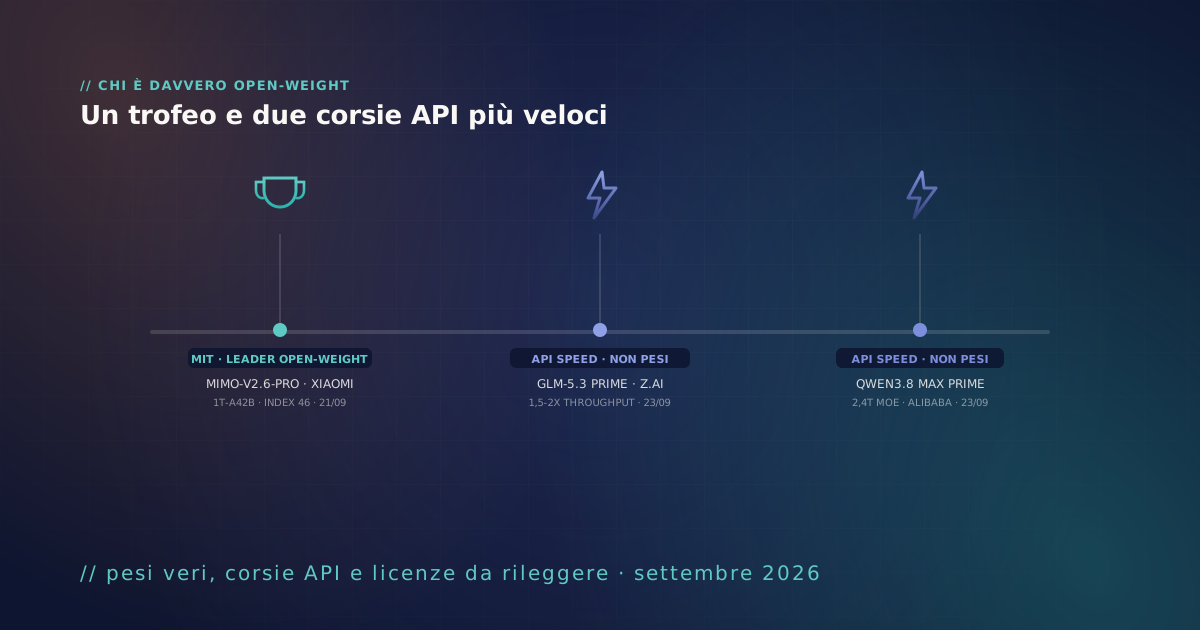
This week's headlines were all about two launches sharing the same suffix — "Prime" — one from Z.ai, one from Alibaba. Neither, though, is a release of new weights: both are faster API lanes for models that already existed. The real open-weight news of the week, which got far less attention, is that a smartphone maker just leapfrogged every well-known Chinese AI lab to the top of the open-weight leaderboard.
MiMo-V2.6-Pro: Xiaomi takes the top of the open-weight leaderboard
On September 21, 2026, Xiaomi published MiMo-V2.6-Pro on Hugging Face, a sparse Mixture-of-Experts model with 1.02 trillion total parameters, only 42 billion of which are active per token, under a plain MIT license — free commercial use, no thresholds, no hidden clauses. According to Artificial Analysis, the model scores 46 on the Intelligence Index, the highest score any open-weight model has ever reached: it beats both Z.ai's GLM-5.3 and Moonshot's Kimi K3, both stuck at 44, and ranks sixth overall once closed models are counted too. The detail that surprised observers most is the reported training cost — around $3 million — far lower than what's normally associated with a model of this size, with a quality-to-price ratio that Artificial Analysis places on the Pareto frontier between intelligence and cost per token. Xiaomi also released MiMo-V2.6-Flash alongside it, a cheaper variant built for higher volumes.
GLM-5.3 Prime and Qwen3.8 Max Prime: two launches that aren't new weights
On September 23, 2026, Z.ai launched GLM-5.3 Prime, a high-speed variant of GLM-5.3 that inherits all of the base model's capabilities but delivers 1.5-2x the throughput through inference acceleration, with context up to 1 million tokens and reasoning that is always on — it cannot be disabled, with three effort levels (low, high, max, the latter being the default). It isn't a new checkpoint: it's an API product, priced at $2.80 per million input tokens and $8.80 per million output tokens, aimed at coding and long-horizon agentic orchestration workloads.
The same day, following the September 22 announcement at the Yunqi Conference in Hangzhou, Alibaba activated Qwen3.8 Max Prime, a faster lane for the same Qwen3.8-Max — the 2.4-trillion-parameter sparse MoE model that on August 13 became the first "Max"-class model in the Qwen family to be released open-weight, under Apache 2.0. Qwen3.8 Max Prime uses the same weights, the same 1-million-token context window, and the same tooling as the base model: only speed and price change, with price roughly doubling versus the standard version ($4 vs. $2 per million input tokens, $12 vs. $6 output). Here too, no new weights to download.
GLM-5.3's license isn't MIT: the clause that matters if you make a lot of revenue
It's worth circling back to the license of the GLM-5.3 base model (753 billion parameters, published on Hugging Face on August 28), because it's a case that shows once again how risky it is to trust the label. Z.ai didn't use MIT or Apache 2.0, but a bespoke document — the "GLM-5.3 License" — that in substance grants the same rights as an MIT license (use, copy, modify, distribute, sublicense, sell, explicitly covering weights, parameters, configuration files, and training and inference code), with one added clause that makes the difference: Model-as-a-Service operators above a given revenue threshold must undergo a security review. Two days earlier, the same lab had released GLM-5.3-Flash instead — 320 billion total parameters, 18 billion active, the first natively multimodal model (text, image, video) in the GLM-5 series — under a plain, unmodified MIT license, without that clause. Same lab, same week, two different licenses for two models in the same family.
What actually matters if you're evaluating an AI architecture today
- A name ending in "Prime," "Turbo," or "Speed" often just means a faster API lane, not a new downloadable checkpoint: always check whether a weights repository actually exists before calling it an open release.
- The open-weight leaderboard changes hands quickly — this week it's a consumer electronics maker, not one of the well-known AI labs, leading it: don't lock an architecture to a single month's ranking.
- Even within the same model family, licenses can differ substantially: the GLM-5.3 flagship imposes a security review above a revenue threshold, GLM-5.3-Flash doesn't. Read every single release, not just the family label.
- A much lower reported training cost, as with MiMo-V2.6-Pro, says nothing about quality for your specific use case: always verify it with a real test, not with the vendor's development budget.
It's exactly the work we do every week with our clients: telling a genuine weights release apart from a new API lane carrying the same model name, reading the exact license of each release — not the previous one's — and building an architecture where the right model runs where it needs to run, with your data staying yours, regardless of which lab trained the model or which leaderboard it leads this week.
- VentureBeat — "Better than DeepSeek": Xiaomi's MiMo-V2.6-Pro debuts as the top open weights model in the world ↗
- Artificial Analysis — MiMo-V2.6-Pro model page ↗
- Latent Space (AINews) — "Xiaomi MiMo-V2.6-Pro 1T-A42B: the new top Open Weights model, trained for $3M" ↗
- OpenRouter — GLM 5.3 Prime, specs and pricing ↗
- Digital Applied — "GLM-5.3's Weights Are Out. The Licence Is Not MIT" ↗
- Hugging Face — zai-org/GLM-5.3-Flash, MIT license text ↗
- OpenRouter — Qwen3.8 Max Prime, specs and pricing ↗
- Eigent — "Qwen3.8-Max: Alibaba's 2.4T Open-Weight Coding Model" ↗