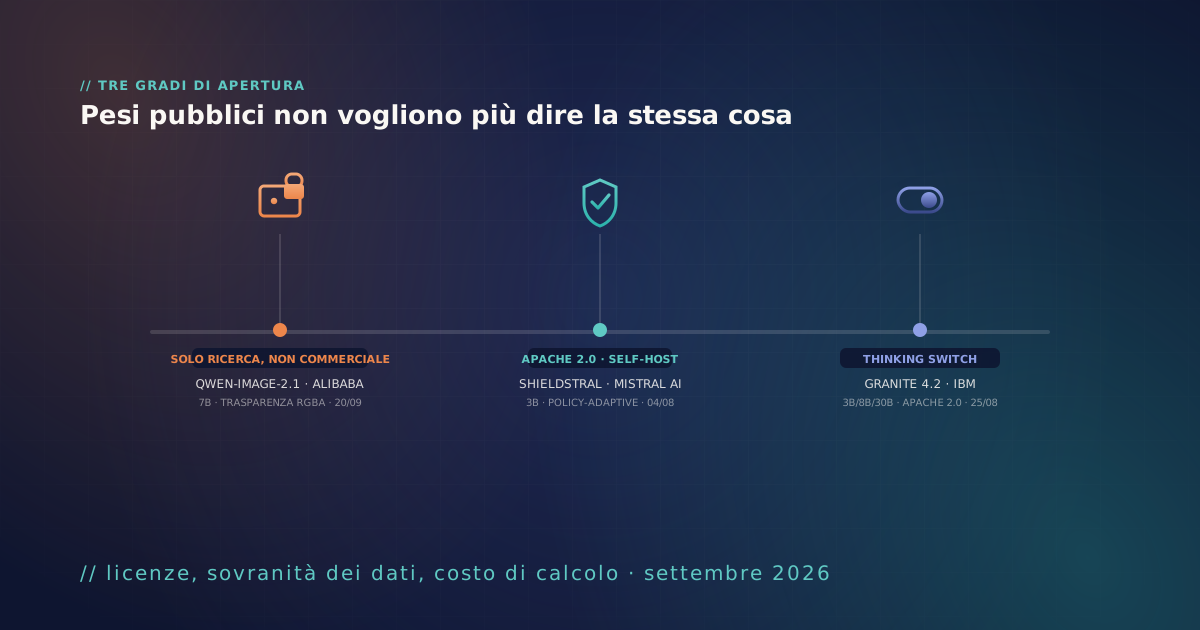
Three releases from recent weeks tell three very different stories about openness, and none fits the usual "open-weight" label cleanly. On September 20, 2026, Alibaba published Qwen-Image-2.1 with weights anyone can download, but forbidden in production without a separate commercial contract. A few weeks earlier, on August 4, Mistral had released Shieldstral, a 3-billion-parameter safety classifier under a genuine Apache 2.0, built explicitly to run on the servers of whoever downloads it. And on August 25, IBM added Granite 4.2, three reasoning models with a switch that decides whether to think step by step or answer right away. Taken together, the three releases are a useful reminder: "public weights" no longer means anything precise until you read the license, release by release.
Qwen-Image-2.1: the weights download freely, but you can't use them in production without asking
On September 20, 2026, Alibaba's Qwen team published Qwen-Image-2.1, a 7-billion-parameter image generation and editing model built on a 32-layer Single-Stream DiT architecture. The technical advances are concrete: the model writes transparency natively (RGBA format), instead of generating on a solid background and cutting the subject out with a separate matting model; it accepts up to ten reference images in a single composition; it supports local editing and output up to 2K; and it reuses the KV cache to treat input images and editing instructions as static context computed once, cutting memory use and inference time. The weights are on Hugging Face, ModelScope and GitHub, with day-zero support in ComfyUI, Diffusers, vLLM-Omni and SGLang.
The surprise is in the license. The previous generation, Qwen-Image, shipped under Apache 2.0 — as permissive as MiniCPM5-2B, which we covered last week. Qwen-Image-2.1 instead arrives under the Qwen Research License Agreement, which the text published on GitHub defines without ambiguity: use is granted only "for research or evaluation purposes", and anyone wanting commercial use must first obtain a separate license by writing to model-business@notice.qwencloud.com. Anyone distributing a derivative must also prominently display "Built with Qwen" or "Improved using Qwen", and cannot use the Qwen name as their product's primary identifier. In practice: the weights are as public and inspectable as an open source model's, but using them to generate images inside a commercial product — even just an internal tool producing marketing content — requires a contract that, today, simply doesn't exist yet in public form.
Shieldstral: a genuine counter-example, built specifically to run on your own
On August 4, 2026, Mistral AI released Shieldstral, a multimodal safety classifier with 3 billion parameters under Apache 2.0 — no thresholds, no commercial-use clause, no contract to sign. It runs on a single 16GB GPU and evaluates both text and images. What sets it apart from traditional guardrails is that it's "policy-adaptive": instead of being retrained every time the moderation policy changes, it accepts the policy in plain language directly at inference time and returns a calibrated safety score. In Mistral's own tests it beats models up to seven times its size. For a company that needs to enforce its own content-moderation rules — not ones decided by a third-party cloud provider — it's a concrete example of what real openness looks like: you can download it, run it on your own servers, change the policy whenever you want, and never let content leave your perimeter.
Granite 4.2: IBM bets on three open sizes with a switch for reasoning
On August 25, 2026, IBM published Granite 4.2, a family of decoder-only reasoning models in three sizes — 3, 8 and 30 billion parameters — all under Apache 2.0 and available on Hugging Face. The interesting feature is the "thinking switch": the same checkpoint can reason step by step on a complex task or answer directly on a simple one, without needing two separate models. On the SWE-bench Verified benchmark, the 30-billion model scores 57.00. For anyone evaluating a local deployment, the combination of modest sizes, a clean license and explicit control over "how much to reason" translates into a more predictable compute cost — a detail that matters as much as the license when planning an infrastructure budget.
What actually matters for anyone evaluating an AI architecture today
- The license needs re-reading on every release, even within the same product line: Qwen-Image was Apache 2.0, Qwen-Image-2.1 no longer is. A project's name guarantees nothing about its next release.
- "Downloadable weights" and "usable in production" are two different claims: always check whether the license requires a separate commercial contract before integrating a model into a product or service.
- An open safety classifier like Shieldstral, run on your own servers, lets you enforce your own moderation policies without routing content through a third party's API — a direct benefit for data sovereignty.
- You don't always need the biggest model: a family like Granite 4.2, with an explicit switch for reasoning, lets you size compute cost to the actual task instead of always paying for full reasoning.
This is exactly the work we do every week for our clients: reading the exact text of every license before an adoption, telling a genuinely open model apart from one that only looks the part, and choosing the architecture — large or small, general-purpose or specialized — that guarantees compliance and ownership of your data, not the one making the most headlines.
- GitHub — QwenLM/Qwen-Image-2.1, license text (Qwen Research License Agreement) ↗
- CellCog — "Qwen-Image-2.1: 7B Open Weights You Cannot Ship" ↗
- Tech Insider — "What Alibaba Actually Shipped on September 20" ↗
- Runtime Wire — "Alibaba releases Qwen-Image-2.1 with transparent editing and research-only weights" ↗
- Mistral AI — "Introducing Shieldstral" (official announcement) ↗
- MarkTechPost — "Mistral AI Releases Shieldstral 1.0 3B" ↗
- DataNorth AI — "IBM releases Granite 4.2: Open Reasoning Models" ↗
- eesel AI — "IBM Granite 4.2: models, benchmarks, pricing, and what's new" ↗