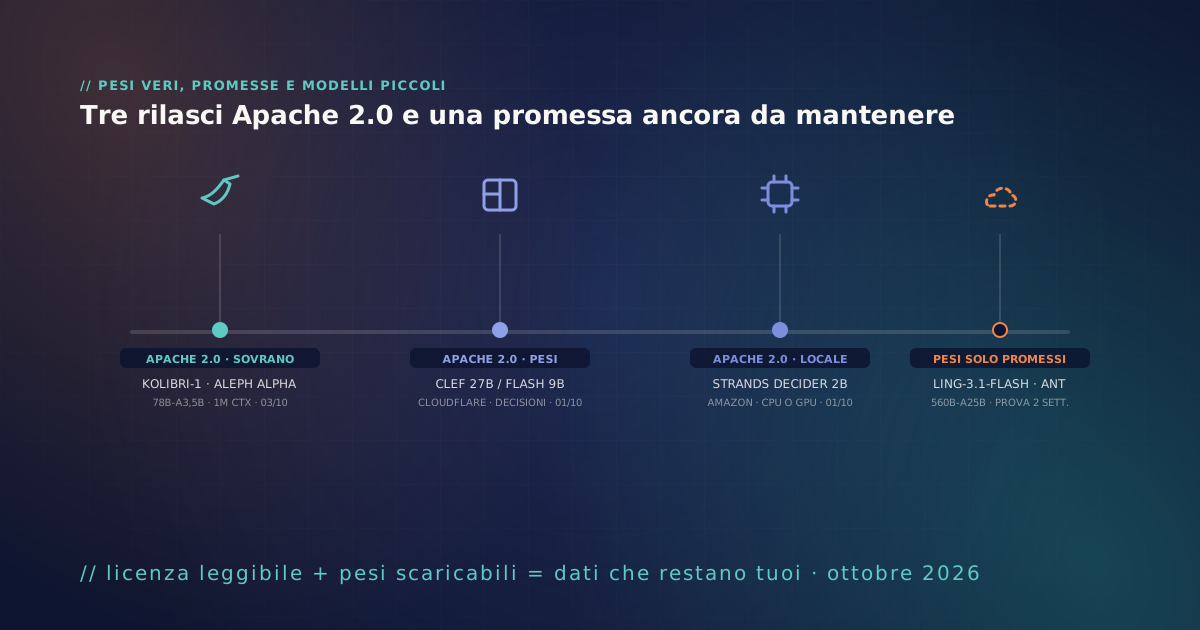
After a week of loud announcements, the first days of October 2026 bring quieter open-weight releases that are far more useful to anyone building a compliant AI architecture: a European model with full weights, two families of "decision" models designed for agents, a translation model, and one big announcement that, for now, includes no downloadable weights.
Kolibri-1: Aleph Alpha's sovereign model, with Apache 2.0 weights
On October 3, 2026, Aleph Alpha published Kolibri-1 on Hugging Face, a Mixture-of-Experts model with 78.1 billion total parameters and 3.46 billion active per token, bilingual English and German, under an Apache 2.0 license. The context reaches about one million tokens (trained to 256k, extended to 1M with configuration), with a reasoning mode and tool calling. The company says it was built in Germany, trained on infrastructure in Germany and Finland, under European and German law, with no foreign control, on roughly 20 trillion training tokens of which about 4.3 trillion are German. With only 3.46 billion active parameters, the company says it can serve 18 concurrent 256k-token requests on two H100 GPUs: a size within reach of on-premises infrastructure or a Swiss sovereign cloud. Weights are available in FP8 and BF16.
Cloudflare Clef and Amazon Strands Decider: models that return probabilities, not text
On October 1, Cloudflare released Clef (27B) and Clef-flash (9B), with weights on Hugging Face under Apache 2.0, also available on Workers AI. They are "decision models": they receive a state and a set of typed questions and return a probability for every allowed answer, so an agent can route a ticket, block a request or hand off to a person in a verifiable way. The same day Amazon published Strands Decider 2B, a 2-billion-parameter decision model that runs locally on CPU or GPU, with weights, training data and scripts, also under Apache 2.0. For compliance the interest is concrete: a decision with explicit probabilities is far easier to log and audit than free text.
Index-Translate-35B-A3B: translation in 150 languages, still a preview
On October 2, Bilibili's Index team published a preview of Index-Translate-35B-A3B, a MoE with 35 billion total and 3 billion active parameters, a 262,144-token context and support for 150 text languages, under Apache 2.0. The dense 2B and 9B siblings had already reached Hugging Face on September 28. Being a preview, it should be evaluated on your own documents before any production use.
Ling-3.1-flash: a promise of weights is not a release
Ant Group's InclusionAI introduced, between late September and early October, Ling-3.1-flash, a model with 560 billion total and about 25 billion active parameters, aimed at agents, search and office applications, with a context designed for up to one million tokens (capped at 256k during the two-week free trial). InclusionAI says it intends to release the model as open source after the trial. Until the weights are on a repository with a readable license, however, for a company that must guarantee where its data runs it is an API service, not an open model.
What actually matters if you're evaluating an AI architecture today
- "Open source coming soon" is not "open-weight": until downloadable weights and a readable license exist, the model can't be part of an architecture that guarantees data ownership.
- Small, specialized models, such as decision or translation models, are often the simplest way to keep sensitive data in-house: they run on a single GPU or even on CPU.
- Provenance matters: a model with a declared supply chain, European training and an Apache 2.0 license, like Kolibri-1, simplifies the documentation required by the FADP and GDPR, but still has to be validated on your use case.
- Previews are not products: always test models on your real documents before building a process on a vendor's benchmark.
It's the work we do every week with our clients: telling genuinely downloadable weights from announcements, reading the license of every single release, and building an architecture where the right model runs where it needs to run, with your data staying yours.
- Aleph Alpha — Kolibri has landed: a sovereign open-weight model ↗
- Hugging Face — Aleph-Alpha/Kolibri-1 (Apache 2.0) ↗
- Startup Fortune — Aleph Alpha puts Kolibri's full weights on Hugging Face under Apache 2.0 ↗
- Cloudflare Changelog — Introducing Clef: Cloudflare's first open-source decision models ↗
- MarkTechPost — Cloudflare Releases Clef and Clef-flash ↗
- Digital Applied — AI Model Releases: October 2026 Tracker ↗
- TechNode — Ant Group launches Ling-3.1-flash with 560 billion parameters ↗
- Artificial Analysis — Ling 3.1 Flash ↗