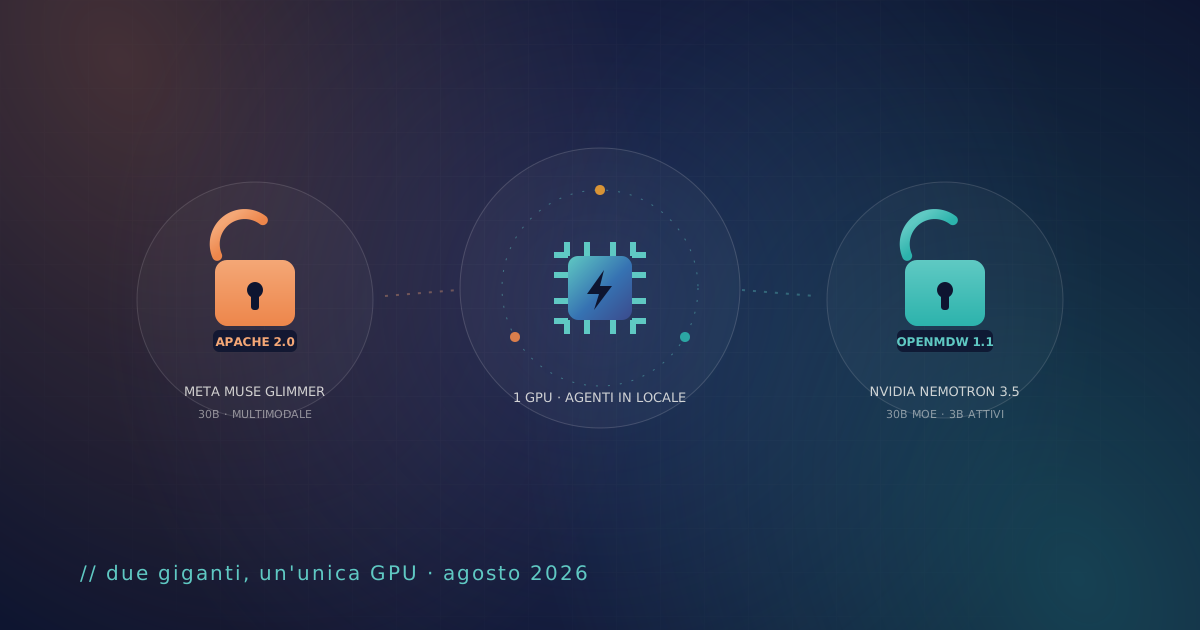
In the same week of August 2026, two of the biggest AI infrastructure vendors published open-weight models within hours of each other. On August 10, Meta released Muse Glimmer, reversing the closed strategy it had adopted for the Muse family back in April. The next day, August 11, Nvidia published Nemotron 3.5 Lightning — its first open source model ever. These aren't two isolated stories: they're a sign that open weight is no longer territory reserved for AI labs alone, but is becoming the standard even for vendors that until now mostly sold chips or closed infrastructure.
Muse Glimmer: Meta reverses its closed strategy
Muse Glimmer is a 30-billion-parameter dense model, released under the Apache 2.0 license — permissive, well understood, with no surprise geographic clauses. It's built to run on consumer hardware: a single laptop with a discrete GPU is enough. It handles text and images, was trained on more than 100 languages, and is already downloadable on Hugging Face, with integrations announced for Ollama, LM Studio, llama.cpp, ExecuTorch and MLX. What matters most, though, is the context: when Meta launched the Muse family in April 2026, it kept it closed, accessible only via API. Muse Glimmer is an explicit reversal of that choice — and Mark Zuckerberg has already said weights for Muse Spark 1.2, the family's more capable model, are coming too.
Nemotron 3.5 Lightning: the specs of a model built for a single GPU
Nemotron 3.5 Lightning is a Mixture-of-Experts model with 30 billion total parameters but only 3 billion active parameters per token — light enough to run on a single GPU, including consumer-grade setups. Nvidia released not just the weights but also the training data and recipes, under the OpenMDW-1.1 license, governed by the Linux Foundation: free commercial use, no permission required, no royalties. The model is explicitly built for agents that need to run for a long time on a specialized task: Nvidia claims up to 4x faster output and 30% faster task completion compared with similar models. Alongside Nemotron, Nvidia also released NeMo Switchyard, a router that directs each request to the most suitable model in a multi-model pipeline.
Why now: Jensen Huang's public conversion
Nemotron 3.5 Lightning arrives just weeks after Jensen Huang first publicly defended the open source approach, in late July 2026. It's the first open model Nvidia has published since its CEO took a public stance on the topic. For a company that built its value on selling GPUs, pushing lightweight open models — that happen to run well on the very GPUs it sells — isn't just an ideological choice: it's a strategy that widens the base of people who need its hardware for local inference, instead of relying solely on the big labs' APIs.
The difference from last week: here, the license holds up to scrutiny
Last week we covered how Qwen3.8-Max was announced as open with no weights or license published on launch day. Here the picture is the opposite: both Meta and Nvidia released weights and license — and in Nvidia's case, training data and recipes too — the same day as the announcement, under permissive, standard licenses with no known geographic restrictions. That's not a minor detail: it means that, unlike other recent cases, you can read the license text today and know exactly what you're allowed to do, instead of waiting for a future release that might not arrive as promised.
What changes, in practice, for anyone evaluating an AI architecture in their company
- 30-billion-parameter models, often with only a few billion active parameters, that run on a single GPU concretely lower the cost threshold for self-hosting: you no longer need a cluster to get started.
- Permissive, well-understood licenses like Apache 2.0 and OpenMDW-1.1 reduce the risk of having to redesign your architecture in six months because terms changed — a real advantage over licenses written ad hoc by a single vendor.
- Models explicitly built for long-running agents, like Nemotron 3.5 Lightning, signal where the market is heading: no longer just chatbots, but automated processes that need to stay active for hours on infrastructure you control.
- When two vendors of this scale normalize open weight in the same month, choosing a closed model for lack of mature alternatives becomes harder and harder to justify.
This is exactly the kind of week-by-week check we run for our clients: not just watching which model tops a benchmark, but understanding which vendors are actually publishing weights, license and training data together — on infrastructure you can size and host yourself, without depending on a future promise.
- VentureBeat — Meta returns to open source with Muse Glimmer, a 30-billion-parameter model under the Apache 2.0 license ↗
- CNBC — Meta launches the open-weight Muse Glimmer model ↗
- CNBC — Nvidia releases Nemotron 3.5 Lightning, its first open source model ↗
- MarkTechPost — Nvidia releases Nemotron 3.5 Lightning and the NeMo Switchyard router ↗
- NVIDIA Developer Blog — official technical page for Nemotron 3.5 Lightning ↗
- Hugging Face — official model card for Nemotron 3.5 Lightning ↗