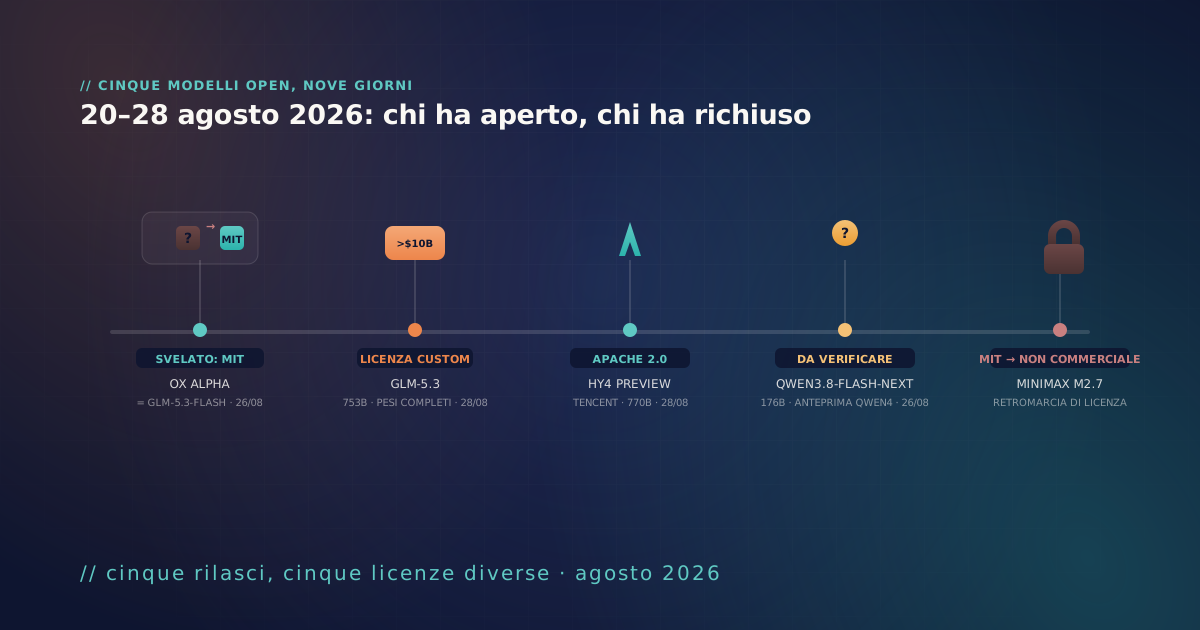
In last week's roundup we wrote about Ox Alpha, the nameless model that showed up on OpenRouter and OpenCode, and closed with a blunt warning: if you can't name the company running it, don't send it trade secrets or sensitive data. The mystery lasted exactly one week: on August 26, Zhipu (Z.ai) revealed that Ox Alpha was in fact GLM-5.3-Flash, run incognito on a cluster of roughly 100,000 domestically produced Chinese chips, capable of processing 100 trillion tokens a day during the stealth trial. It's just the first of five open-weight releases packed into nine days, between August 20 and 28 — together they tell a more useful story than any leaderboard about where the open-model market is heading, and why the license, once again, matters more than the podium.
Ox Alpha had a name after all, and it was MIT-licensed from day one
GLM-5.3-Flash is a Mixture-of-Experts model with 320 billion total parameters, only 18 billion of them active per token: the first natively multimodal model in the GLM-5 family, handling text, images, video, and visual documents in interleaved input. Before the official reveal, the model had already processed 62 trillion tokens incognito, and in its first three days on OpenRouter it topped 11 trillion tokens — the platform's biggest launch on record. Zhipu's shares in Hong Kong closed up more than 12% the day after the announcement. But the detail that matters for a business evaluating adoption is different: the weights are on Hugging Face under a plain MIT license, no acceptable-use rider, no hidden thresholds. The Ox Alpha case closes in the best possible way — but the fact that it took a week to learn who was behind it is the lesson to keep: until you know the vendor, our warning from two weeks ago still stands.
GLM-5.3's full weights land, under a different license than its smaller sibling
On August 28, Z.ai also published the full weights of GLM-5.3, the 753-billion-parameter model we wrote about two weeks ago in connection with the thousand-plus critical vulnerabilities found during post-training and the resulting security review. Here, though, the surprise is in the license: unlike GLM-5.2 and GLM-5.3-Flash itself, both under plain MIT, GLM-5.3 ships under a bespoke license — the text is nearly identical to MIT except for one added clause: any Model-as-a-Service operator with more than $10 billion in revenue must complete a security review before offering the model to its customers. It's a threshold clearly aimed at large hyperscalers, not a company self-hosting internally — but it's another reminder that, within the same model family from the same lab, two releases published two days apart can carry two different licenses. Checking the license of the specific model you download remains the only way to know for sure.
Tencent enters with Hy4 Preview, and picks the simplest path: Apache 2.0
That same August 28, Tencent released and open-sourced Hy4 Preview, a Mixture-of-Experts model with 770 billion total parameters, 49 billion active per token, and a context window past one million tokens. According to independent comparative tests, it tops the SWE-bench Pro leaderboard and beats both GLM-5.3 and Kimi K3 in blind software-engineering evaluations. One detail worth noting: Tencent says it used Hy4 during its own development to automate part of its training-method optimization, and the model even helped optimize its own inference infrastructure, delivering a measured 31.8% throughput increase. On the license front, though, Tencent made the simplest choice in this whole roundup: genuine, unrestricted Apache 2.0, the same license already seen across most of the Qwen family. No revenue threshold, no review clause, no surprise buried in the fine print.
Qwen3.8-Flash-Next: a preview of the Qwen4 architecture, license to verify model card by model card
On August 26, Alibaba released Qwen3.8-Flash-Next, a preview of the architecture that will underpin Qwen4: 176 billion total parameters — 51 billion of them in a new embedding table indexed on bigrams and trigrams, designed as a scaling axis that's computationally cheaper than pure Mixture-of-Experts — with only 6 billion parameters active per token. It's built to run on much lighter hardware than the trillion-parameter giants of the past few weeks. On licensing, though, the sources we checked don't agree: some report Apache 2.0, others the Qwen Community License 1.0, which is more restrictive in certain large-scale deployment scenarios. This is exactly the kind of discrepancy we always recommend resolving by reading the license file published with that specific checkpoint on Hugging Face, not a third-party summary — our own rule, applied to a real case this week.
The MiniMax case: yesterday's permissive license is no guarantee for tomorrow's
The most instructive case this week, for anyone focused on compliance rather than benchmarks, is MiniMax. The company built its reputation among developers by releasing M2 under MIT in October 2025 and M2.5 under the same terms in February 2026. With M2.7, made broadly available in recent weeks, that streak of permissive releases broke: the model is still downloadable, but under a "Modified-MIT" license that reserves free use to personal and non-commercial research purposes only — any commercial use, including self-hosting for business purposes or fine-tuning for a paid product, now requires prior written authorization from MiniMax. The developer community reacted sharply, calling the move "faux open source," precisely because the "Modified-MIT" name still evokes the openness of the original license while quietly changing its substance. The context isn't irrelevant: the change comes a few months after MiniMax's listing on the Hong Kong Stock Exchange in January 2026.
It's the most concrete case we've seen so far of a principle we've repeated for months: a model's license isn't a stable property of its family or its lab — it's a condition tied to that specific release, and it can change from one version to the next without warning. A company that built a commercial product on M2 or M2.5, assuming the same permissive regime would automatically carry over to M2.7, would find itself out of compliance today — not because of a wrong call at adoption time, but for failing to re-check the license at every new version before updating its infrastructure.
The bigger picture behind the five releases: the capability gap is closing, the price gap isn't
Taken together, these five releases confirm a broader trend several independent analysts have flagged in recent weeks: the capability gap between the best open-weight models and the best closed models has narrowed far faster than the price gap, which remains enormous. On comparable benchmarks, open models today trail frontier closed models by only a few percentage points, at a fraction of the cost per token. This isn't just an industry detail: according to the latest estimates, open-weight models now route more than half of all production inference tokens globally, up from a negligible share just two years ago. For a company still weighing whether an open-first architecture is mature enough for a real use case, this week's signal is that the question has shifted: no longer "is the open model capable enough," but "which specific license governs the model I'm about to adopt, and will it still hold at the next version."
What to check, in practice, before choosing one of these models
- Don't rely on a model family's "historical" license: GLM-5.3-Flash and GLM-5.3, published two days apart by the same lab, carry different licenses. Check the one published with the specific checkpoint you plan to use.
- When secondary sources disagree on the license — as with Qwen3.8-Flash-Next this week — always go to the original license file on Hugging Face before building anything on top of it.
- The MiniMax case shows that a permissive license on one version is no guarantee for the next: if your product depends on an open model, re-check the license at every update before shipping it, not just at first adoption.
- If you don't know the vendor behind a model — as was the case for a week with Ox Alpha — treat it as an unidentified vendor in every respect: no sensitive data, no trade secrets, until a verifiable name and contract emerge.
This is exactly the check we run every week for our clients: not stopping at the lab's name or its leaderboard position, but reading the license published that specific day for that specific checkpoint — because, as the MiniMax case shows, the license that holds today is no guarantee for tomorrow's, and building an architecture that stays compliant means re-checking it at every version, not just at first adoption.
- South China Morning Post — Zhipu shares jump as viral Ox Alpha model revealed as GLM-5.3-Flash on Chinese chips ↗
- TechNode — Zhipu identifies Ox Alpha as GLM-5.3-Flash and releases model weights ↗
- The New Stack — Z.ai's GLM-5.3 goes open weight, but its new license aims at hyperscalers ↗
- Tencent — official announcement of the Hy4 Preview open-source release ↗
- Simon Willison — technical notes on the Hy4 Preview release ↗
- MarkTechPost — Alibaba releases Qwen3.8-Flash-Next, a preview of the Qwen4 architecture ↗
- Decrypt — MiniMax drops a state-of-the-art agent model, then quietly changes the license ↗
- Requesty — five open-weight releases in nine days and the collapse of the capability premium ↗