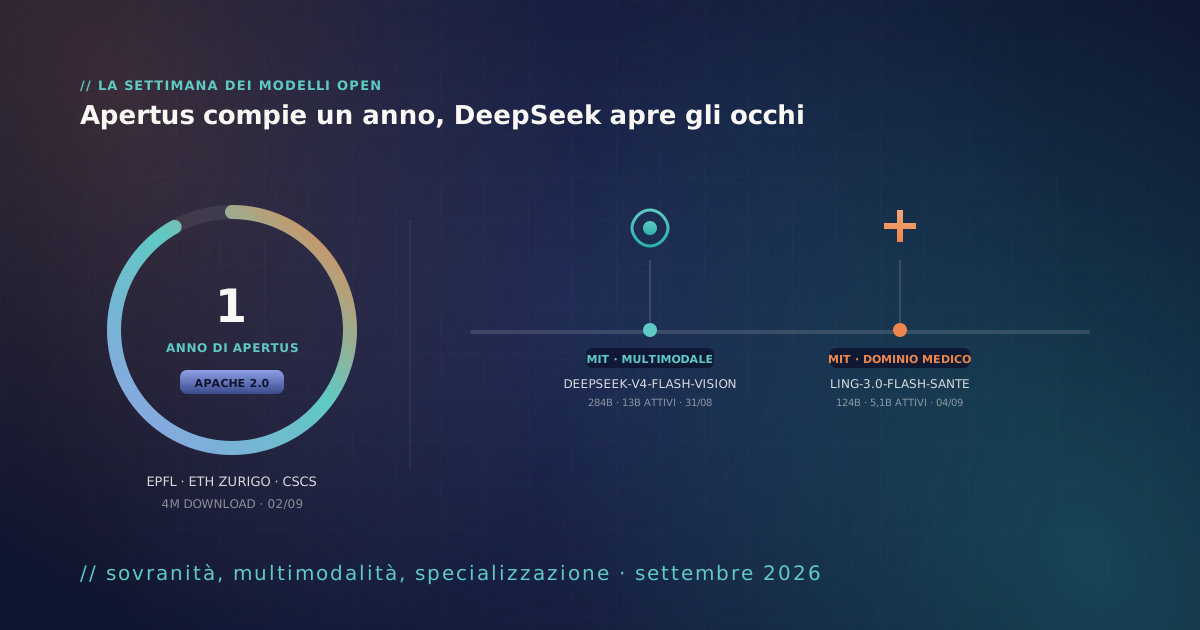
Three stories from the first week of September 2026 capture where open models stand right now, even though they have little in common besides landing in the same handful of days. On September 2, Apertus — the open model built in Switzerland by EPFL, ETH Zurich and CSCS — turned one, with a report card worth reading closely if you handle sensitive data in this country. On August 31, DeepSeek published the first multimodal model in its V4 family, under a clean MIT license. On September 4, Ant Group released a variant of its Ling-3.0 model specialized for healthcare. Three releases, three licenses, and three distinct lessons for anyone evaluating an AI architecture today.
Apertus, one year on: 4 million downloads, but sovereignty alone isn't enough
Apertus — Latin for "open" — is the language model built by EPFL, ETH Zurich and the Swiss National Supercomputing Centre (CSCS), launched on September 2, 2025 under an Apache 2.0 license: not just the weights, but the training data, architecture and training recipes are public and documented, available in 8-billion and 70-billion-parameter versions. A year later, according to the report published by Swissinfo on September 2, the model has passed 4 million downloads and found concrete applications: in June, EPFL presented MeditronFO, a fully open framework for building clinical AI models built on top of Apertus, and CSCS uses it to power an in-house machine translation service for the canton of Ticino.
July brought Apertus 1.5, which added image and audio understanding, an explicit reasoning mode and a fourfold-longer context window of roughly 262,000 tokens, plus better support for tool calling and complex instructions. But the same report card doesn't hide the limits: on agentic capability Apertus still lags behind other open-weight models, and running the 70-billion-parameter version well is, as the article puts it, "an infrastructure project, not a download-and-go." For the team behind it, the second year still comes down to two challenges: improving the model itself, and strengthening the ecosystem of tools around it.
For a Swiss company evaluating nLPD compliance, Apertus remains today the cleanest starting point on sovereignty: trained in Switzerland, publicly documented, runnable on infrastructure under your own control, with no license ambiguity to check. But sovereignty of origin doesn't replace a capability check: if your use case requires complex agentic behavior, the one-year report card suggests testing it on the real task before taking it for granted, not choosing it just because it's "the Swiss model."
DeepSeek opens its eyes: the first multimodal model in the V4 family, under a clean MIT license
On August 31, DeepSeek published on Hugging Face the weights of DeepSeek-V4-Flash-Vision-Exp, the first experimental multimodal model in the V4 family: built on top of the DeepSeek-V4-Flash architecture, with vision modules added and a further training cycle to unlock understanding of images and visual documents. The specs remain those of a high-end Mixture-of-Experts model: 284 billion total parameters, of which 13 billion are active per token, 256 routed experts plus one shared expert, and a native context window of up to 1 million tokens.
On the license front there are no surprises to hunt for between the lines: the file published in the repository is plain MIT text, with no appendix and no acceptable-use clause, granting the full spectrum of rights — use, copy, modify, distribute, sublicense, sell — with no thresholds tied to revenue, commercial use or derivative models. It's a direct contrast with what we saw two weeks ago with GLM-5.3, published under a bespoke license aimed at large hyperscalers: for anyone evaluating a document-understanding or image-analysis pipeline to host internally, a multimodal model of this scale under clean MIT removes license ambiguity from the checklist entirely.
Ling-3.0-Flash-Sante: when an open model specializes in a regulated domain
On September 4, Ant Group, through its inclusionAI lab, released Ling-3.0-Flash-Sante, a variant of its Ling-3.0-Flash model (124 billion total parameters, 5.1 billion active, released under an MIT license on August 5) fine-tuned for the healthcare domain: reasoning over clinical knowledge, evidence-based retrieval, and handling complex medical workflows, while retaining the base model's general reasoning, coding and tool-use capabilities, with a 256,000-token context window.
It's a signal worth noting regardless of your specific use case: open models are starting to specialize in heavily regulated sectors like healthcare, not just compete on general-purpose benchmarks. For now the model is mainly available through hosted APIs — Novita, OpenRouter, Vercel AI Gateway, with a free window through October 4 — convenient for prototyping, but for any workflow handling real clinical data the same old principle still holds: verify where inference runs and where the data ends up before building a production process on top of it, not after.
In the background: the AI Office starts asking for answers
On August 29, European Commission Executive Vice-President Henna Virkkunen confirmed that the AI Office had formally sent requests for information to more than 30 providers of GPAI models, covering model security, independent external evaluations and post-market monitoring. It's the first concrete use of the enforcement powers that took effect on August 2, which we wrote about a month ago: a reminder that requests for technical documentation are no longer hypothetical, and it's worth checking now whether your own provider's — open or closed — would hold up to the same level of scrutiny.
What to check, in practice, this week
- If you're evaluating Apertus for sovereignty reasons, test it on your actual use case before taking it for granted: the Apache 2.0 license and Swiss training are a clean starting point, not a guarantee of sufficient capability for every task.
- DeepSeek-V4-Flash-Vision-Exp shows that a large multimodal model under clean MIT is now available for self-hosting with no clauses to negotiate: if your use case is document or image understanding, it's an option worth weighing alongside Qwen and GLM.
- If you're considering an open model specialized for a regulated domain like healthcare, treat the free API window as a prototyping tool, not as your production architecture: for real clinical data, verify data residency and self-hosting options before integrating.
- With the AI Office already requesting technical documentation from major providers, now is the time to check whether yours, for the model you use today, would hold up to the same request — before someone else asks it for you.
This is exactly the work we do every week for our clients: reading the report cards and licenses published that specific week, checking what actually changes for a Swiss company, and building an architecture where the right model — sovereign, multimodal or specialized — runs where it needs to run, with your data staying yours.
- Swissinfo — one-year review of Switzerland's open model Apertus ↗
- CSCS — Apertus 1.5: Building the next generation of open AI infrastructure ↗
- Hugging Face — DeepSeek-V4-Flash-Vision-Exp, model card ↗
- Hugging Face — inclusionAI/Ling-3.0-flash, model card ↗
- OpenRouter — Ling 3.0 Flash Sante (free) ↗
- Agence Europe — European Commission sends first requests for information to more than 30 AI providers ↗